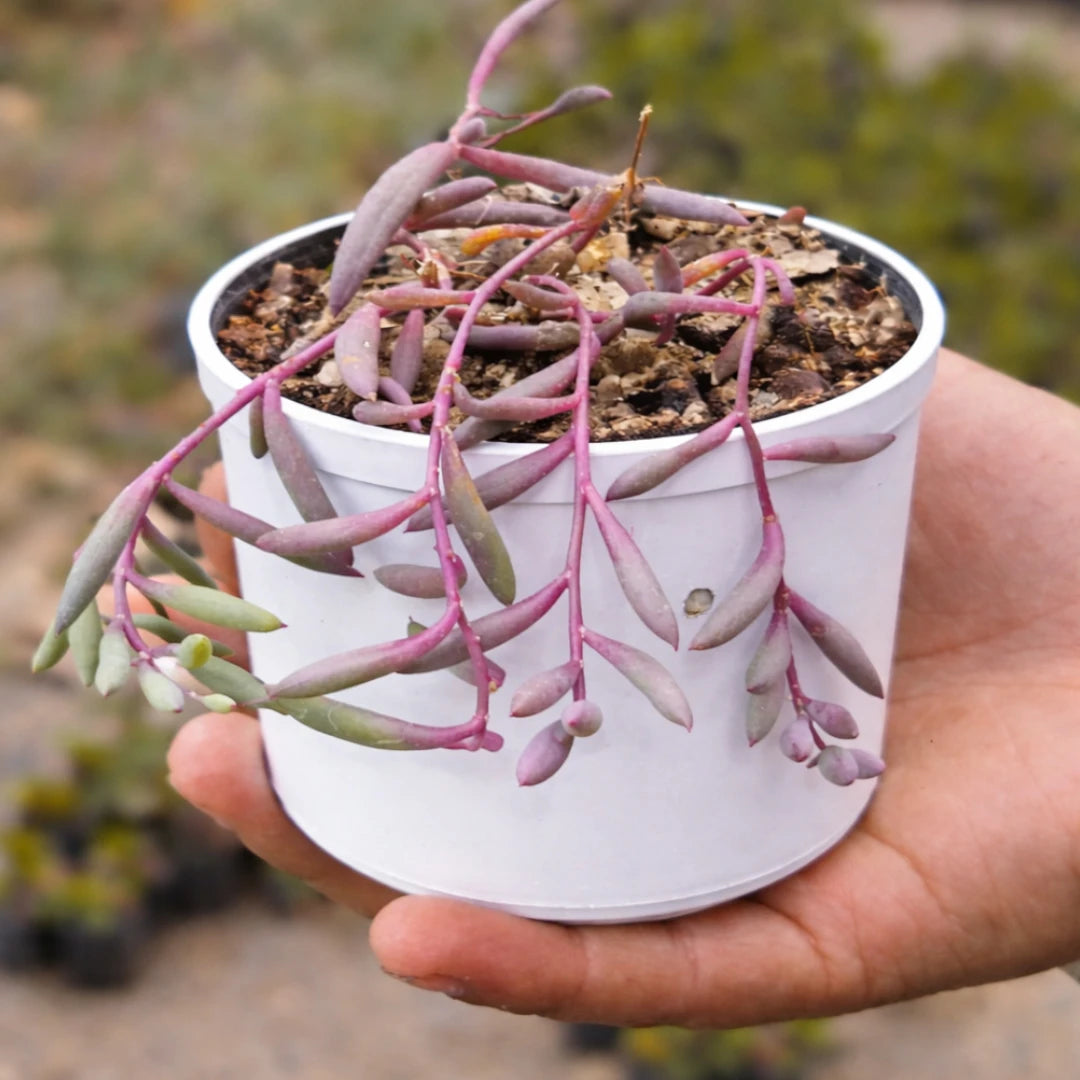
potting bare root succulents Ruby Necklace Plant – Trailing Purple Succulent
SKU: 53420801714
potting bare root succulents

potting bare root succulents Ruby Necklace Plant – Trailing Purple Succulent

Sale price$23.27 Regular price$25.86
Save 10%

Pay in installments of $6.46 with ShopPay, AfterPay and Klarna

Shipping Estimate
USA
  • USA
  • CAN

Ships within 48 hours · Estimated delivery Jun 29 - Jul 4

Promo Codes Available:

For Your Every Summer RSVP, with Code: SUMMER15

Description

potting bare root succulents Ruby Necklace Plant – Trailing Purple SucculentDispatch in 2 3 days Country of origin: India It's Compulsory to make unboxing video of parcel for refunds within 24 hours. Bare Rooted Overview of Othonna Capensis Common Name: String of Rubies, Ruby Necklace, Little Pickles Botanical Name: Othonna capensis Family: Asteraceae Type: Succulent Mature Size: 212 inches long, 48 inches wide Native Area: South Africa Hardiness Zones: 9 11 (USDA)Othonna capensis, commonly known as the String of Rubies or

  • Dispatch in 2-3 days
  • Country of origin: India
  • It's Compulsory  to make unboxing video of parcel for refunds within 24 hours.
  • Bare Rooted

Overview of Othonna Capensis

Common Name: String of Rubies, Ruby Necklace, Little Pickles
Botanical Name: Othonna capensis
Family: Asteraceae
Type: Succulent
Mature Size: 2–12 inches long, 4–8 inches wide
Native Area: South Africa
Hardiness Zones: 9-11 (USDA)Othonna capensis, commonly known as the String of Rubies or Ruby Necklace, is a popular trailing succulent characterized by its vibrant, fleshy leaves that can turn a striking ruby red when exposed to bright sunlight. This plant is not only visually appealing but also relatively easy to care for, making it a favorite among succulent enthusiasts.

Care Instructions

Light Requirements

  • Ideal Exposure: Othonna capensis thrives in full sun to partial shade. It requires at least six hours of direct sunlight daily. Indoors, place it near a bright south-facing window or under strong grow lights to maintain its vibrant color.

Soil and Potting

  • Soil Type: Use a well-draining soil mix, such as cactus or succulent potting mix. A mixture of two parts succulent soil and one part perlite or pumice is ideal for excellent drainage.
  • Potting Tip: Ensure pots have drainage holes to prevent water accumulation.

Watering

  • Watering Schedule: Allow the soil to dry out completely between waterings. Water thoroughly when the top inch of soil is dry, typically every 1 to 3 weeks depending on environmental conditions.
  • Signs of Overwatering: Yellowing leaves or mushy stems indicate overwatering, which can lead to root rot.

Temperature and Humidity

  • Optimal Temperature: This succulent prefers temperatures between 65°F to 85°F (18°C to 29°C) and should not be exposed to temperatures below 50°F (10°C) for extended periods.
  • Humidity Needs: Othonna capensis thrives in low humidity environments typical of its native habitat.

Fertilization

  • Feeding Schedule: Fertilize sparingly during the growing season (spring and summer) with a diluted fertilizer low in nitrogen. Frequent fertilization is not necessary.

Common Issues

Pests

  • Othonna capensis can be susceptible to pests such as mealybugs and aphids. Regularly inspect the plant for signs of infestation and treat promptly if needed.

Diseases

  • Overwatering is the primary concern for this succulent. Proper watering techniques are essential to prevent root rot.

Frequently Asked Questions

  1. How often should I water my Othonna capensis?
    Water when the top inch of soil feels dry, typically every 1 to 3 weeks depending on the season and environmental conditions.
  2. Can I grow Othonna capensis outdoors?
    Yes, it can be grown outdoors in USDA hardiness zones 9 to 11 but should be protected from frost and extreme cold.
  3. Why are my plant's leaves turning yellow?
    Yellowing leaves may indicate overwatering or insufficient light. Adjust your watering habits and ensure adequate sunlight exposure.
  4.  How do I propagate Othonna capensis?
    Propagation can be done through stem cuttings. Allow cuttings to callous for a few days before placing them in well-draining soil. Keep the soil barely moist until roots establish.
  5.  Is Othonna capensis toxic?
    This plant is generally considered non-toxic; however, it’s best kept away from pets and small children who may ingest parts of the plant.By following these care guidelines, Othonna capensis can thrive, adding vibrant color and unique beauty to your indoor or outdoor garden space.
Shipping Notes
  • Free Standard Shipping on $100+ Orders to the USA.
  • Except Preorder products are shipped in 48 hours.
  • Delivery to the USA:
  1. Standard Shipping : 3-10 business days
  • If time is of the essence, please consider selecting expedited delivery for faster service.
Exchange/Return Notes
  • We offer a 30-day return/exchange service after receiving.
  • Final sale items are not eligible for returns or exchanges.
  • To process your return/exchange, please contact us at [email protected]
  • Please click here for more details>>> Return & Exchange Policy
SKU: 53420801714

Discover Niche Categories That Outsell potting bare root succulents

Top-Converting Item to Boost Your Average Order

4.0 ★★★★★
Based on 2124 reviews
Sort
Highest Rating
Newest First
Oldest First
Product Reviews
K
Verified Purchase
KK
Grantham, US
★★★★★ 5
No taste
Size: 8 Ounce (Pack of 1)
Really good. I put it in my black coffee. There’s no taste or complaints. My second purchase.
WAS THIS REVIEW HELPFUL?YesReportShare
Reviewed in the United States on March 31, 2026
R
Verified Purchase
Ryan Mease
Massapequa, US
★★★★★ 5
Excellent Tool for Approaching Homer via English
Format: Hardcover
I love the Loeb editions of Homer. I've already ready the Odyssey, now moving on to the Iliad. What I've especially started to enjoy with this volume of the Iliad is the editors decision to "call out" which lines were rejected by which ancient commentators (Aristarchus, etc.). This adds some fun to the reading because you get to review the line in Greek and try to surmise why they rejected it, or how the passage would work without the line. The translation is reasonably modern but still "lordly" and has the tone of a war epic. It was enjoyable to read aloud in both English and Greek.
WAS THIS REVIEW HELPFUL?YesReportShare
Reviewed in the United States on September 25, 2025
B
Verified Purchase
Bryan Kerr
Bozeman, US
★★★★★ 5
2,800 years worth of people have heard/read Homer
Format: Hardcover
I just finished reading volume 1 of Homer's Iliad published by The LOEB Classical Library in conjunction with Harvard University Press. The translation is by A.T. Murray with revisions made by William F. Wyatt. The LOEB Classical Library is a academically trusted collection of Greek and Latin publications. The translations are normally more literal than those you might find at your local Barnes and Noble, therefore they read more like an archaic form of English. Homer's Iliad can be found on nearly every great works of literature list. Harold Bloom considered Homer to be in the same family with Cervantes, Dante, and Shakespeare. The Iliad has been read for thousands of years, and every reputable honors program includes his works in their required readings lists. His writings influenced Tolkien and George R.R. Martin. His descriptions of war are grotesque and inspiring. The pantheon of deities he created in his stories set the stage for the Greek mythology that followed him. This is the understanding I had when approaching the book. The bar was set rather high and unlike most expectations these ones were surpassed. As I finished reading volume 1, I asked myself, "how could a writer from the 8th century B.C. have achieved so much, when so many from our era have achieved so little?" Homer had no paper trail of literary criticism to follow. He had no classes in writing style and technique, and yet the Iliad is of such a high caliber that we still read him today. Wayne C. Booth brought to our attention Homer's "leave nothing up to the reader" style of reading. If Homer wants you to favor one group over another, he is going to come out and say it. He can tell you every thought and intent of each character. Homer doesn't care that it would be impossible for anyone to know the thoughts of Agamemnon or Hector. He knows what they thought and that's enough. Many writers today shy away from such literary techniques in favor of modes that demand "reader response." This is not necessarily bad, it's just a different approach but many of their works, if not all, will not demand the attention of 2,800 years worth of readers.
WAS THIS REVIEW HELPFUL?YesReportShare
Reviewed in the United States on August 4, 2012
T
Verified Purchase
Tunc
Boise, US
★★★★★ 5
Excellent for learning Homeric Greek
Format: Hardcover
The book is bilingual Homeric Greek-English. It is a Word to word translation of the wonderful ancient text... Reading Iliad is a must for all modern man. With this book, with the help of the opposite page English translation, you can read it in its original too. Homeric Greek is not biblical Greek. It's even older and more beautiful.. So, It may not be the best book for biblical greek readers or learners. But if you are serious about learning ancient Greek and want to do it by reading it word by word with the help of English translation, this book is the right one to start with. Homeric Greek is a dead language, therefore people don't know how to pronounce it. There are many theories about it but there is an interesting guy on YouTube with the nickname "kleber kosta", and he is the best reader of Iliad when it comes to pronouncing it.
WAS THIS REVIEW HELPFUL?YesReportShare
Reviewed in the United States on April 28, 2012
P
Verified Purchase
Patricia Spicer
Los Angeles, US
★★★★★ 5
Homer's Iliad, Books 1-12
Format: Hardcover
This is a wonderful adjunct to any text for anyone interested in Homeric Greek. It reads well in and of itself and seems to be highly accurate. Of course I recommend it.
WAS THIS REVIEW HELPFUL?YesReportShare
Reviewed in the United States on January 24, 2014

recommand products